Your dog is under two and suddenly itchy
Don't buy anything on this list yet. Sudden onset in a young dog is usually fleas, mites or a contact irritant. See a vet first.
Most allergy chews work on the outside of the dog, or on one small part of the inside. We ranked them on whether they reach the place the itching actually starts.

If you're reading this, you've already bought something.
Probably several somethings. A bag of chews that worked for a week. A shampoo that cost more than your own. A food change, then another food change. Maybe a prescription that worked beautifully right up until you stopped, and then didn't.
Here's what nobody tells you when you're standing in that aisle: almost every product on the shelf is aimed at the same two places. The outside of the dog — shampoos, sprays, wipes. Or the bacteria inside the gut — probiotics, prebiotics, fermented blends.
Neither of those is where the problem starts.
About 70% of a dog's immune system sits directly behind the gut wall. When that wall isn't holding, things pass through that shouldn't, the immune system reacts, and that reaction is what you're looking at when you look at your dog's skin. The scratching isn't the problem. It's the readout.
So we ranked these five on one question: does it reach the barrier, or does it manage what the barrier is already leaking?
Six criteria, applied the same way to every product:
Does it work on the allergy reaction itself — or only calm the skin where the reaction showed up?
Does it support the immune system that's driving the reaction — not just the symptom it produced?
Does it cover allergy, immune and gut from one input — or only one of the three?
Does it reach the gut barrier the reaction is coming through — or only add bacteria?
Is it fully dosed with the potency published — actual amounts, not 'contains'?
Is it processed so the actives survive — heat destroys most of what makes colostrum work?
You'll see a lot of pages ranking these by ingredient count. Most complete formula, most actives, most things on the label.
We think that's backwards, and here's why.
A chew with five actives has to fit all five into one small treat. Spirulina for inflammation. Probiotics for bacteria. Postbiotics for the gut. Algae oil for coat. Colostrum for immune. Five jobs, five ingredients, one chew — which means every one of them is in there at a fraction of the amount it would take on its own.
They need five ingredients to cover what one does.
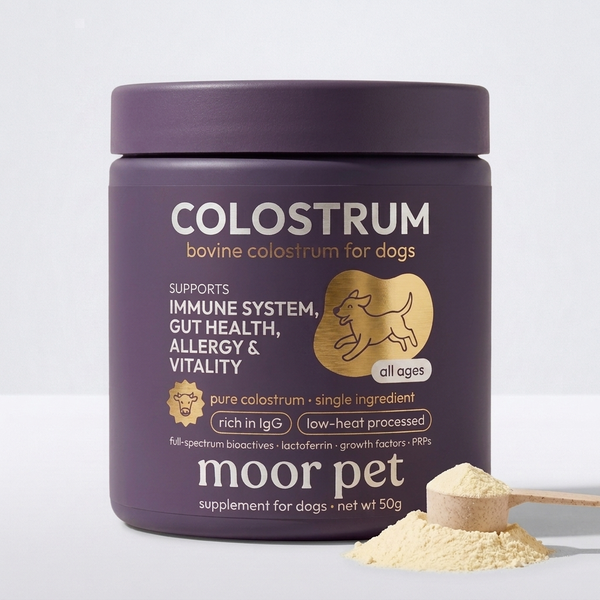
Colostrum is the first thing a newborn gets, and its job is to build an entire gut and immune system from nothing. Gut, immune, skin — that's one input, not five. Which is why it can be fully dosed, because it's the only thing in the jar.
The question isn't how many ingredients are in the jar. It's whether any of them reach the place the problem actually starts.
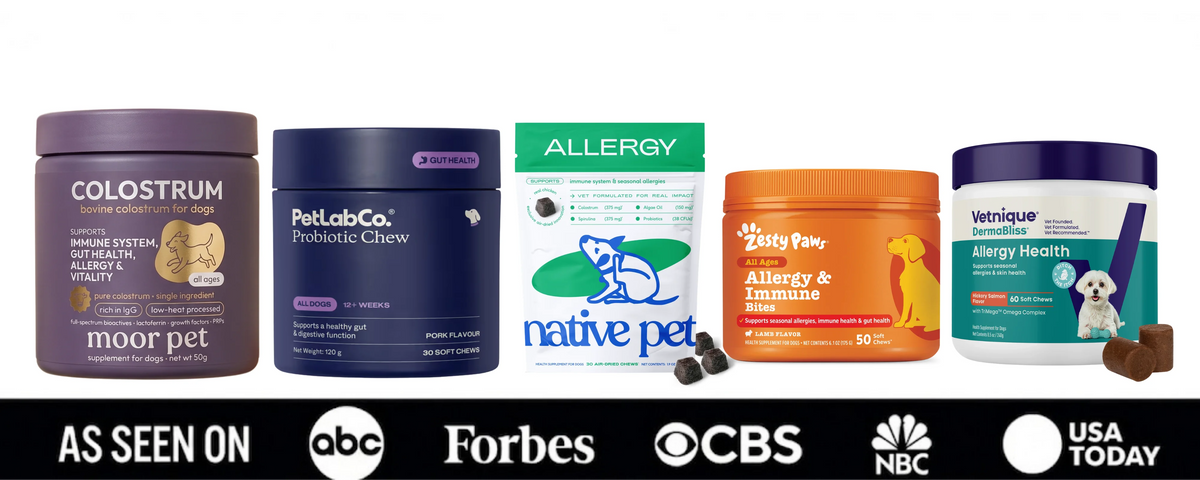
| Criteria | #1 | #2 | #3 | #4 | #5 |
|---|---|---|---|---|---|
| Works on the allergy reaction, not just the skin | YES | partial | partial | partial | no |
| Supports the immune system behind it | YES | partial | partial | partial | no |
| Allergy, immune and gut from one input | YES | no | no | no | no |
| Reaches the gut barrier | YES | no | no | no | no |
| Fully dosed, potency published | YES | no | no | no | no |
| Processed so actives survive | YES | no | no | no | no |
| Contains colostrum | YES | yes | yes | no | no |
Best for: The dog who's already been through everything else

One ingredient that covers all three — allergy, immune and gut.
Why it ranked first: every other product on this list picks one of those and leaves the other two to something you buy separately. Colostrum is the only single ingredient here that handles all three at once, which is why it's the only one that can be fully dosed — there's nothing else competing for room in the jar.
And it works from the inside, which is the part that decides whether it holds. A shampoo calms the skin where the reaction surfaced. A prescription suppresses the response for as long as you keep giving it. A probiotic adds bacteria. None of them touch the barrier the reaction is coming through — which is why the relief ends when the bottle does, and you spend two years renting relief instead of fixing anything.
Colostrum rebuilds the barrier itself. Fix the inside and the outside stops flaring — and it stays calm.
Under the hood: the growth factors rebuild the gut wall and the seals that hold it closed. The prebiotics and lactoferrin reset the bacterial balance. The immune compounds work on the tissue sitting right behind the wall. Three systems, one input.
We publish what's in it. Not 'contains colostrum' — the actual content. Nobody else on this list does.
This is not a four-day product. The gut wall turns over across weeks, and skin follows it on a delay. Most owners see digestion settle in the first couple of weeks and the skin and coat follow over the next month or two. If you want it fixed by Friday, this isn't that. It's backed by a 90-day guarantee for exactly that reason.
It's a powder, not a chew. You sprinkle it on food. Most dogs eat it readily — it's the first food they ever had — but if you specifically want a treat your dog takes from your hand, this isn't it.
Best for: A dog with digestive issues and no skin involvement

The biggest name on this list, and a genuinely competent product. Probiotics plus a small amount of colostrum.
Where it's strong: real probiotic strains, good manufacturing, and they've been doing this long enough to have the basics right. If your dog's issue is loose stool and nothing else, this is a reasonable buy.
Where it falls down: it's a bacteria product. The probiotics work on what lives inside the gut, not on the wall that holds it together — so for a dog whose skin is the symptom, it's working one layer away from the problem.
The colostrum in it is real, but it's one ingredient in a blend and the amount isn't published anywhere we could find.
And it's a soft chew, which means it's been cooked and extruded to hold its shape on a shelf, and colostrum doesn't survive that well.
Verdict: a good probiotic that also says colostrum on the label.
Best for: An owner who wants clean sourcing and is willing to pay for it

The most transparent brand on this list, and the one we'd rank first if the question were ingredient quality alone.
Where it's strong: air-dried rather than extruded, which is a real processing advantage over a standard soft chew.
Short ingredient list by category standards. They talk about sourcing openly, which almost nobody does.
Where it falls down: colostrum is in there, but it shares the formula with several other actives, and like everyone else they don't publish how much.
Air-dried is better than extruded but it's still heat. And the formula is built around calming the immune response rather than rebuilding what's triggering it — useful, but it's management.
Verdict: the best-made blend here. Still a blend.
Best for: A dog with mild, seasonal flare-ups

The most recognizable product in the category, available almost everywhere.
Where it's strong: easy to find, dogs like them, and for a dog with occasional seasonal itchiness they're a reasonable low-commitment option.
Where it falls down: this is the kitchen-sink end of the category. Long ingredient list, proprietary blend, no disclosure on amounts — which in practice means most of what's listed is present in small quantities.
No colostrum. Soft chew format with the usual starch and binder load. It's built to be bought, not to be measured.
Verdict: the one most people try first, and the reason most people end up looking for something else.
Best for: Visible hot spots you need to calm down this week

The only topical product on this list, and we included it because it is what most owners reach for.
Where it's strong: it genuinely works on what it's aimed at. For an active hot spot or a raw patch, a medicated topical gives real, fast relief, and that matters when your dog is miserable right now.
Where it falls down: it is entirely on the outside of the dog. Nothing in it reaches the gut, the immune tissue, or the barrier between them.
Which is why it works for days and the spot comes back — you're treating where the reaction surfaced, not what caused it.
Verdict: good at the thing it does. Not the thing most people are actually trying to fix.
Don't buy anything on this list yet. Sudden onset in a young dog is usually fleas, mites or a contact irritant. See a vet first.
Also probably not allergies. Vet.
Dermabliss, and then come back to this question once it is calm.
PetLab Co.
Worse in the evenings, paws and belly and ears — and you've already done food changes, chews and probably a prescription. The client's copy attributes this to the gut barrier and positions colostrum for support.
The reason none of it lasted isn't the products, and it isn't you.
Almost everything in this category is aimed at the outside of the dog or at one small piece of the inside. If you've cycled through four of them and nothing held, that's not a failure of effort — it's that none of them were ever pointed at the barrier.
Moor Pet Colostrum is 70% off right now, and it ships with free gifts while the sale runs.
It's covered by a 90-day money-back guarantee. Give it the full barrier cycle — if your dog's skin, coat and digestion aren't in a better place than they are today, you get your money back.
Moor Pet Colostrum is 70% off right now, with free gifts while the sale runs.
Give it the full barrier cycle.